GEO PRISM Analysis • Product Architecture • Episode 001 • June 2026 • 8 Minute Read
The Future of AI Travel Isn't a Chatbot
Why high‑trust movement requires timeline‑first orchestration, structured awareness, and continuity under disruption.

Executive Summary
The first generation of AI travel products has focused on helping travelers discover where they should go. Modern systems can compare destinations, recommend hotels, summarize neighborhoods, generate itineraries, and dramatically reduce the time required to plan a trip. For leisure travel, this represents a meaningful improvement in the traveler experience.
Business travel operates under a different set of constraints. The traveler already knows where they need to be. The challenge is ensuring that a sequence of tightly connected events unfolds as intended despite changing conditions. Flights, transportation, meetings, hotels, and timing dependencies form a connected operational chain.
This distinction reveals a gap that is becoming increasingly important as travel systems evolve. Discovery and continuity are not the same problem. One helps travelers decide where to go. The other helps them arrive successfully once that decision has already been made.
The Rise of AI Travel Discovery
Over the past several years, AI travel products have become remarkably effective at assisting travelers during the planning phase of a journey. A traveler can describe a destination, budget, travel style, or set of preferences and receive personalized recommendations in seconds.
These capabilities solve a genuine problem. Historically, trip planning required travelers to navigate multiple websites, compare information across disconnected platforms, and manually assemble an itinerary. AI significantly reduces that friction.
The result is a new category of travel software focused on discovery. Discovery systems help answer questions such as where to go, where to stay, what flight to choose, and how to structure an itinerary. These systems are valuable because they simplify decision‑making before travel begins.
Discovery and Continuity Are Different Problems
Discovery focuses on choice. Continuity focuses on execution. Discovery is concerned with identifying the best option from a set of possibilities. Continuity is concerned with preserving outcomes after a decision has already been made.
An executive traveling to New York for a client meeting faces a different challenge than a vacationer planning Italy. The destination is already known. The hotel is already booked. The meeting is already scheduled. The question is no longer “What should I choose?” but “How do I stay on schedule when conditions change?”
The Continuity Gap
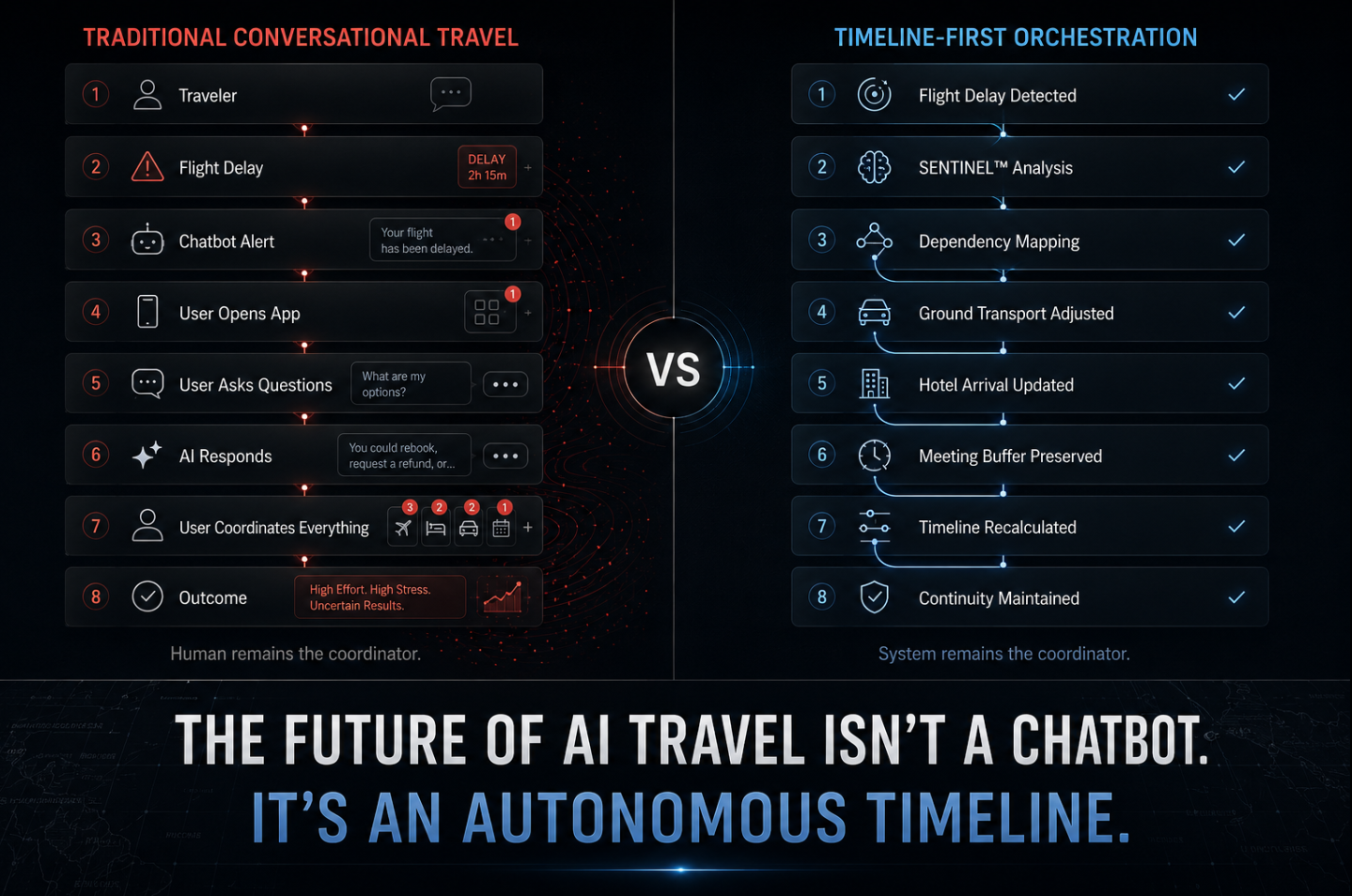
Business travel is often described as a collection of reservations. Operationally, however, it behaves very differently. Flights affect transfers. Transfers affect arrivals. Arrivals affect meetings. What appears to be a minor disruption at the beginning of an itinerary can propagate through the entire movement chain.
This is what GÖ.AI refers to as the Continuity Gap. The gap emerges when information exists but no system understands how the components relate to one another. Most travel applications notify users that something changed. Few systems understand what that change means.
The Anti‑Chatbot Thesis
The purpose of this briefing is not to argue that conversational interfaces are ineffective. In many situations they are exceptionally useful. The stronger argument is that conversational intelligence and continuity intelligence solve different problems.
A traveler experiencing a disruption often does not want another conversation. They want resolution. The future of high‑trust travel systems may be measured by how little conversation they require when disruption occurs.
Why ETAS™ Exists
ETAS™—The Enhanced Travel Automation Suite—was designed around this challenge. Most travel software focuses on helping travelers make decisions. ETAS™ focuses on helping travelers maintain continuity after decisions have already been made.
Instead of asking what the traveler should do next, ETAS™ attempts to answer what the timeline should do next. A delay becomes an orchestration event. A transportation change becomes a timeline adjustment. A disruption becomes a continuity problem to solve rather than a notification to acknowledge.
Not a recommendation engine. Not a booking engine. A continuity engine.
Preference Intelligence vs Operational Intelligence
Most recommendation systems operate primarily on preferences: preferred airlines, hotels, destinations, budgets, and experiences. These inputs help determine what the traveler wants.
Operational intelligence focuses on a different question: what is the environment likely to do next? Infrastructure reliability, weather conditions, transportation corridors, traffic patterns, event density, and dependency chains influence whether a plan remains viable.
Why SENTINEL™ Matters
If ETAS™ is responsible for orchestration, SENTINEL™ is responsible for awareness. Most travel systems react to disruption after it occurs. SENTINEL™ is built around a different premise: what if continuity risk could be identified before disruption begins?
Rather than focusing solely on reservations, SENTINEL™ evaluates the operational environment surrounding movement itself. The objective is not merely to understand what happened. The objective is to estimate what is likely to happen next.
The Coordination Era
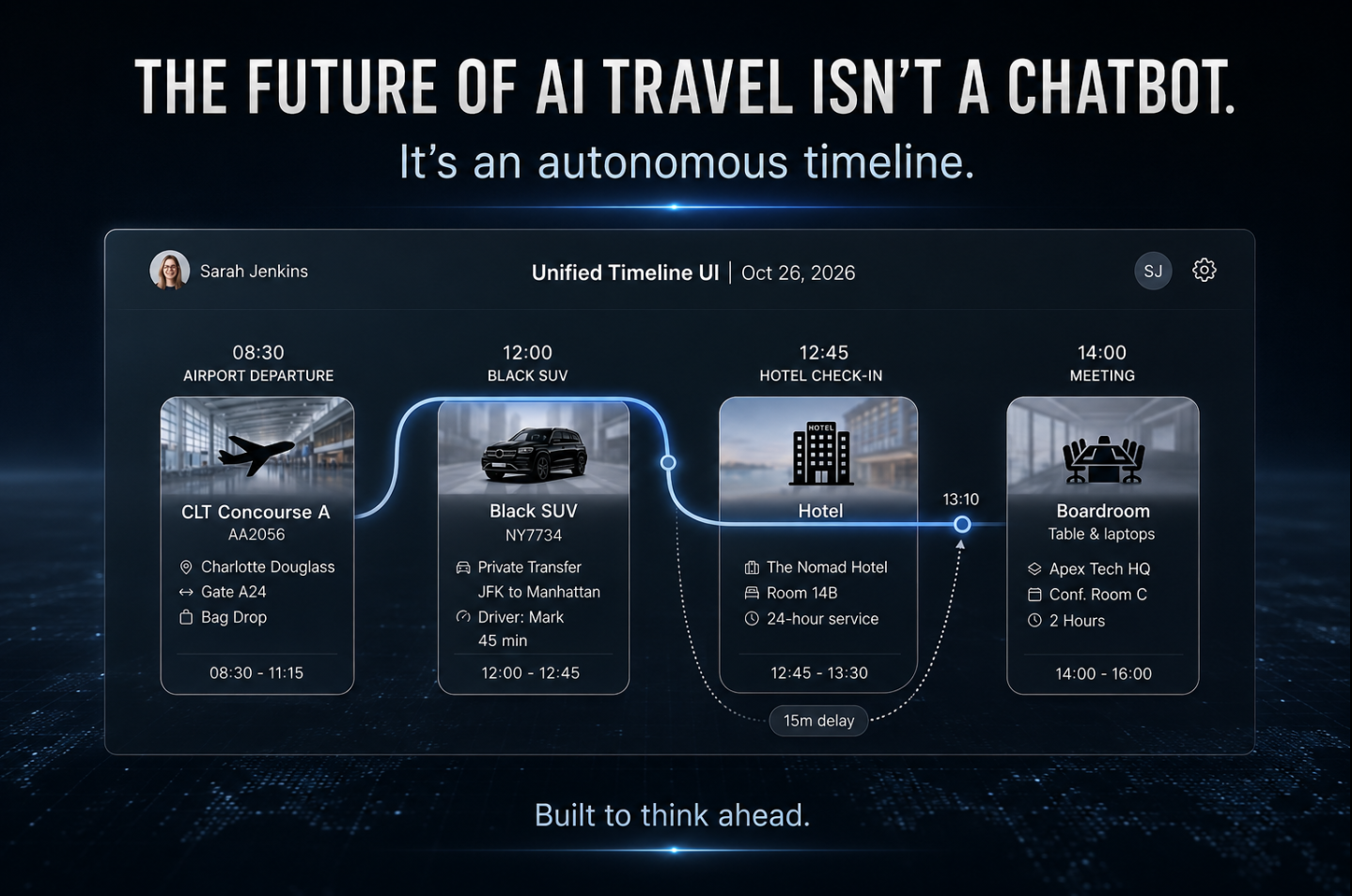
Travel technology has evolved through several distinct phases. The first era focused on access. The second focused on booking. The third focused on recommendations. The next era may focus on coordination.
Recommendation engines help travelers create plans. Coordination systems help those plans survive contact with reality. As travel becomes increasingly interconnected, the competitive advantage may shift away from who can provide the best recommendation and toward who can maintain continuity most effectively.
GÖ.AI Perspective
The future of AI travel is not a better booking engine. It is not a better recommendation engine. And it is not a better chatbot. Those systems solve the discovery problem.
GÖ.AI is focused on the continuity problem. Discovery helps travelers decide where to go. Continuity helps them get there. That distinction forms the foundation of ETAS™, SENTINEL™, and the broader GÖ.AI thesis.
Key Findings
- Discovery and continuity solve different categories of problems.
- Conversational AI excels at travel discovery.
- Business travel is fundamentally a coordination challenge.
- ETAS™ focuses on continuity after decisions are made.
- SENTINEL™ focuses on operational context.
- The next era of travel technology may be defined by orchestration rather than recommendation.